

01
Manual bottleneck
Expert time is consumed by repetitive recon, endpoint review, and report assembly before judgment begins.
Triadix AI Pentest
Triadix turns AI-assisted security testing into a managed run: verified scope, isolated execution, visible subagents, evidence-backed findings, and downloadable reports.
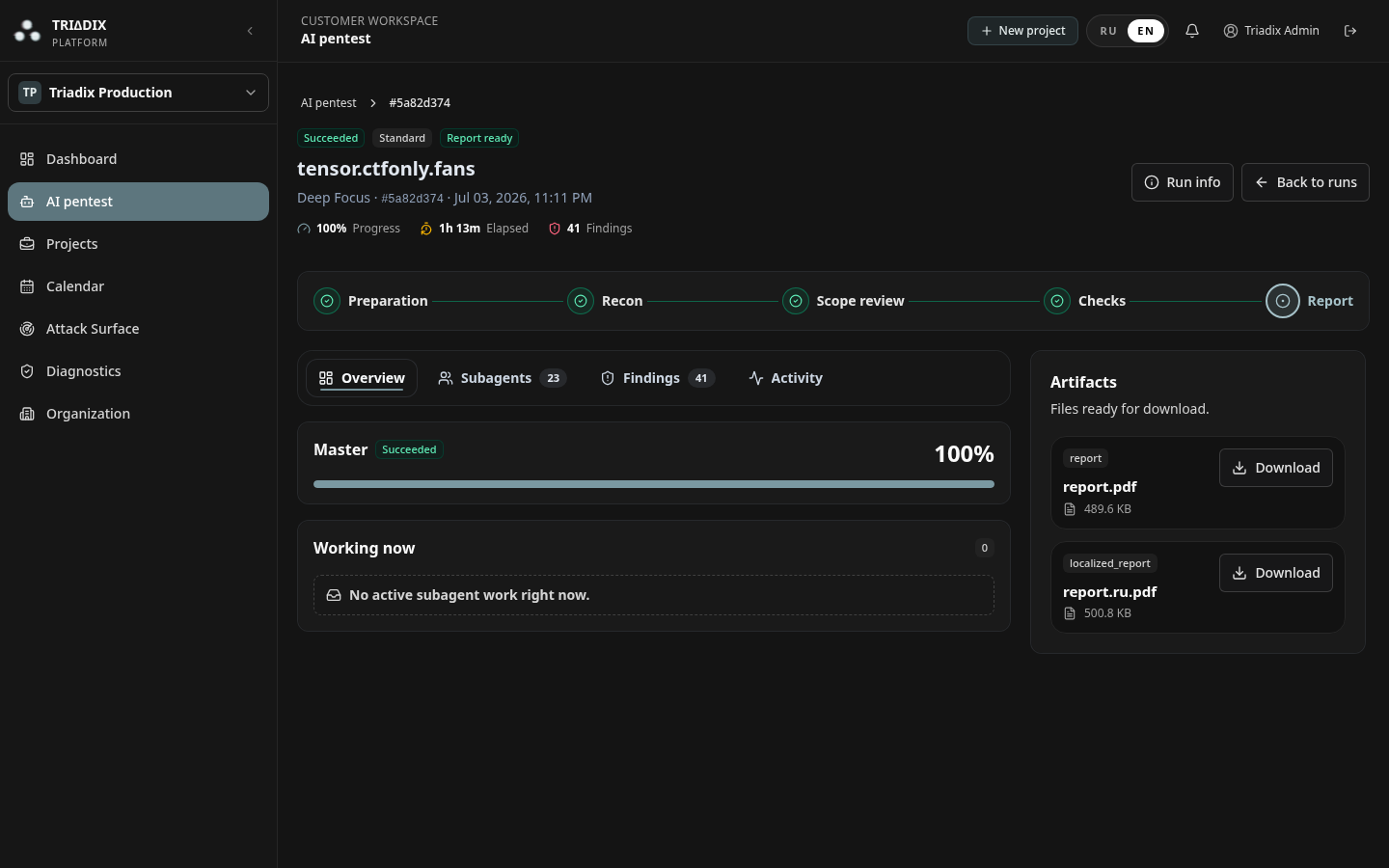
Why it matters
Teams want AI speed, but assessment work still needs authorization, evidence, review, and a clear delivery path.
Expert time is consumed by repetitive recon, endpoint review, and report assembly before judgment begins.
Scanners, browser traces, notes, proof points, and status updates are often disconnected.
Unbounded agents can cross scope, hide decisions, or create traffic nobody approved.
Product promise
Triadix keeps scope, orchestration, review, evidence, and reporting inside one product workflow.
The run starts from an explicit, authorized target context.
Named subagents, approvals, events, and artifacts remain visible while work is running.
Signals are reviewed before they become findings and downloadable reports.
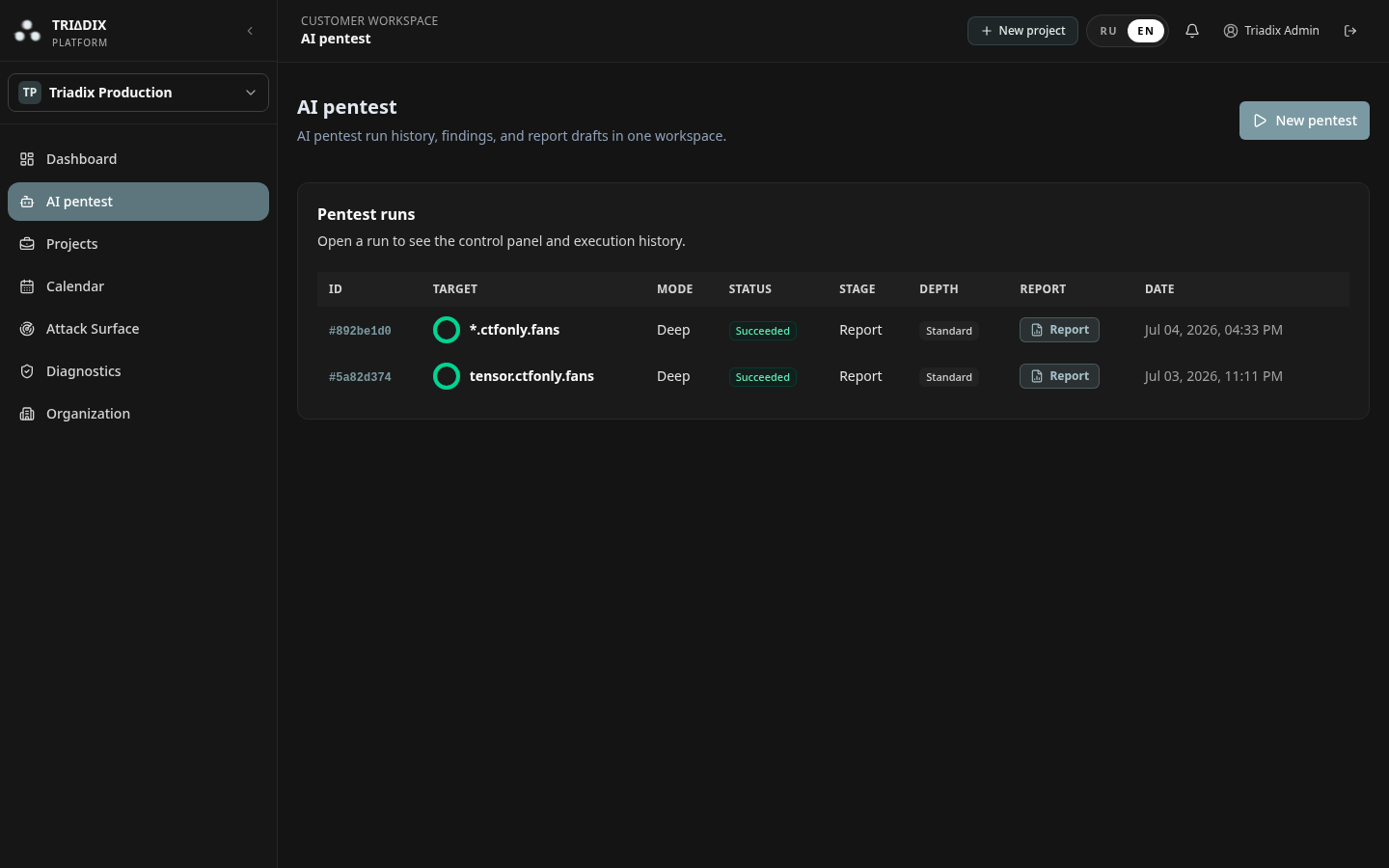
Workflow
The user sees a controlled assessment lifecycle instead of an autonomous process hidden behind prompts.
Define the authorized targets, task description, profile, and risk level.
Start the assessment with an immutable launch context and clear status.
A master agent delegates narrow branches and keeps progress accountable.
Signals, proof points, and summaries are inspected before delivery.
Findings, impact, remediation, and artifacts are packaged for the customer.
Architecture
Triadix separates the product control plane from target-facing execution so governance does not depend on a prompt alone.
Runs, permissions, events, findings, artifacts, and reports stay in the product control plane.
Target-facing work executes in a separate runner environment with policy and resource boundaries.
Workers operate against explicit scope and report progress back into the platform.
Proof points and summaries are normalized into findings and downloadable materials.
Triadix Platform
Runs, permissions, events, findings, artifacts, and reports stay in the product control plane.
Isolated Runner
Target-facing work executes in a separate runner environment with policy and resource boundaries.
Authorized Scope
Workers operate against explicit scope and report progress back into the platform.
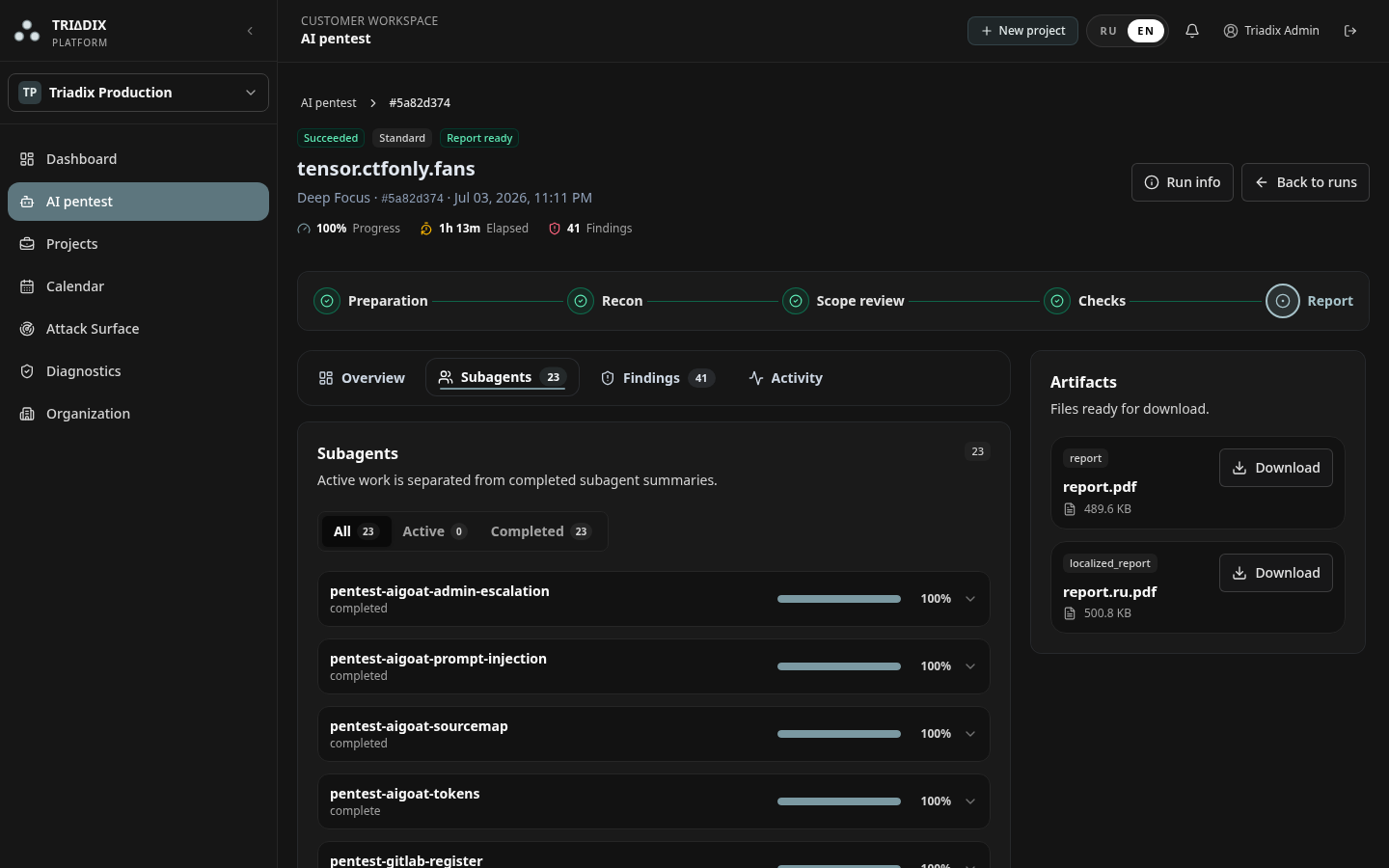
Multi-agent execution
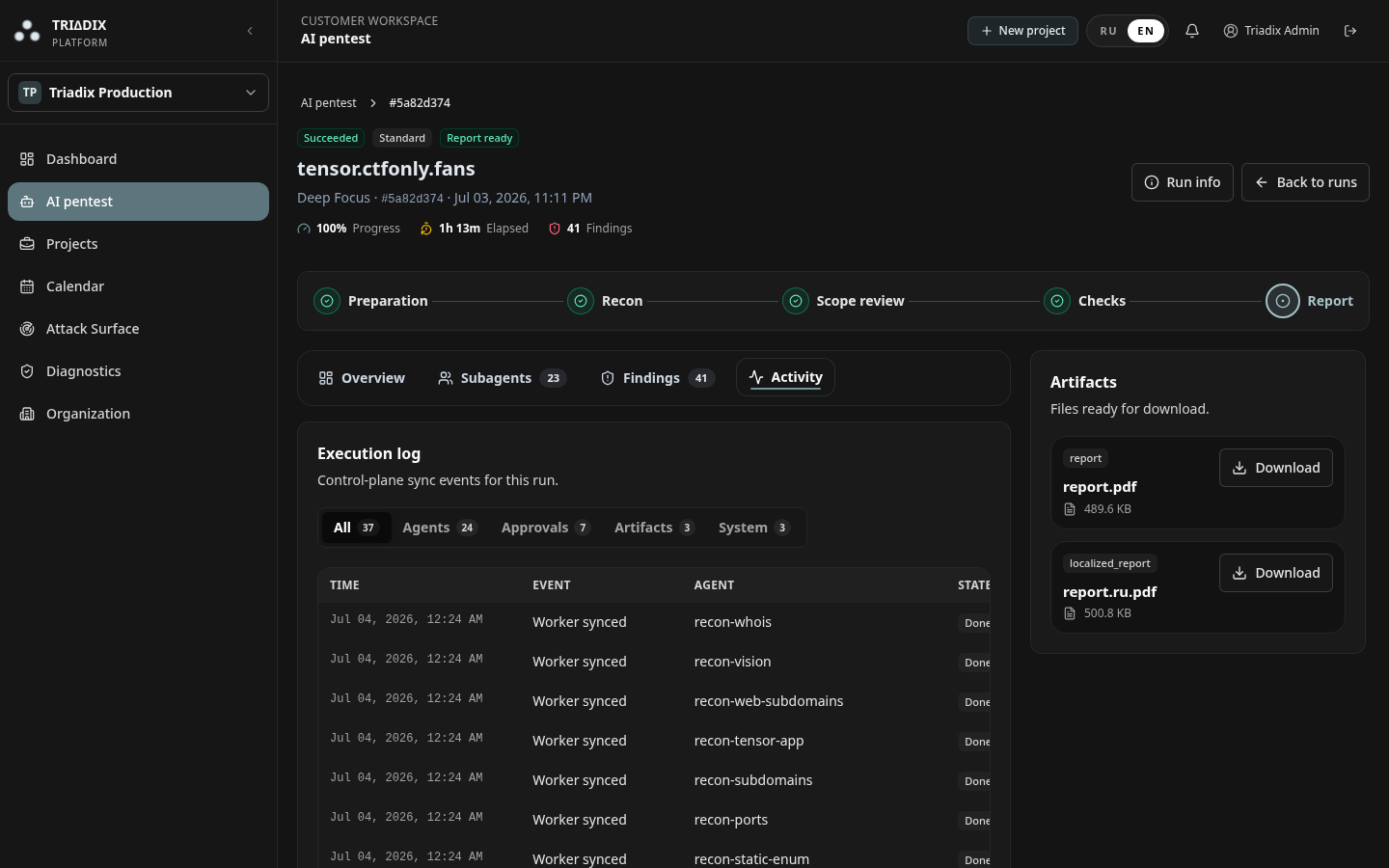
Parallel work is broken into named branches, each with progress, summaries, and artifacts the operator can inspect.
Each subagent has a focused task instead of an invisible background thread.
The UI shows running, completed, blocked, and approval-aware work states.
Operators can review summaries, milestones, and evidence linkage before handoff.
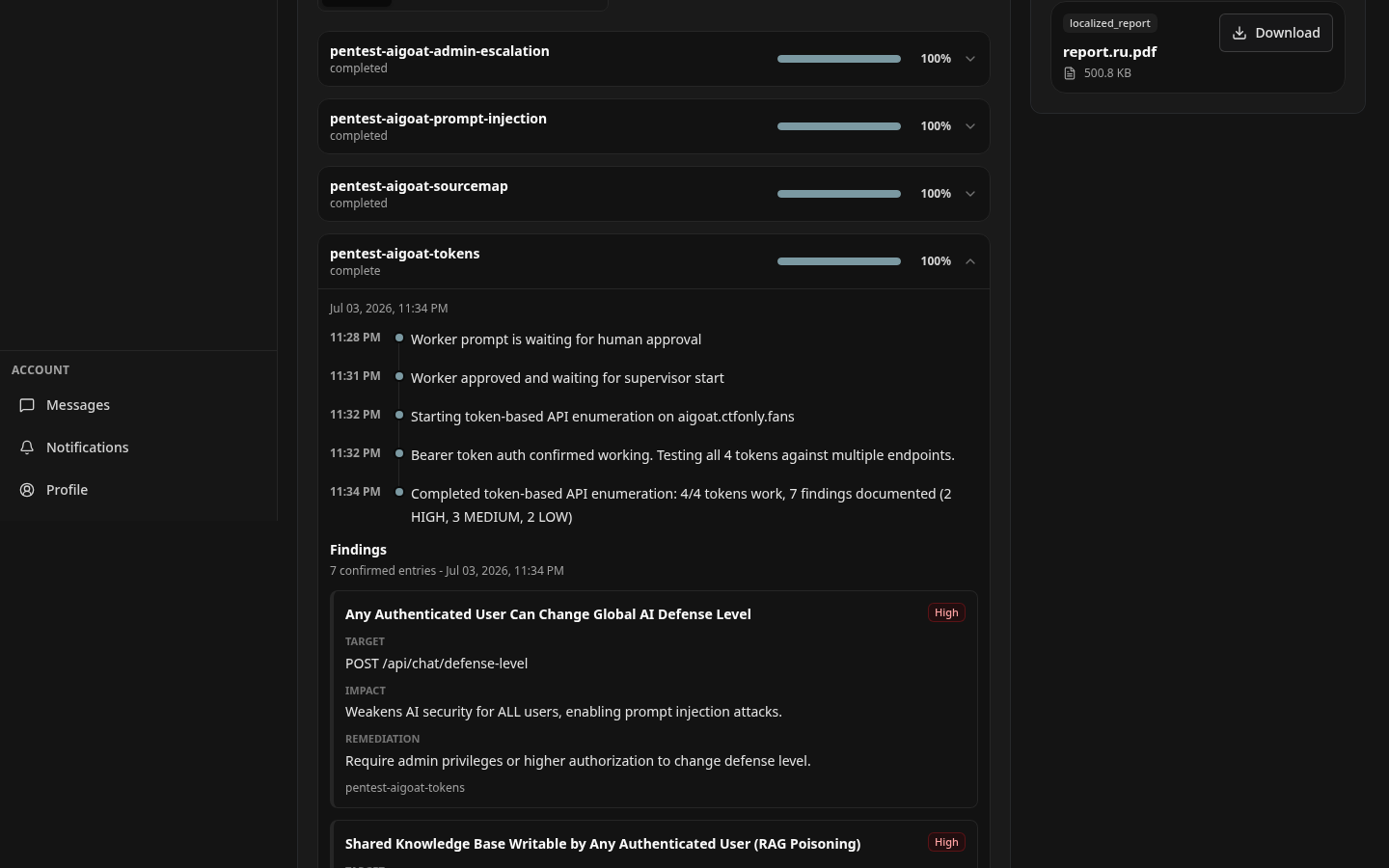
Each subagent has a focused task instead of an invisible background thread.
The UI shows running, completed, blocked, and approval-aware work states.
Operators can review summaries, milestones, and evidence linkage before handoff.
Outcome
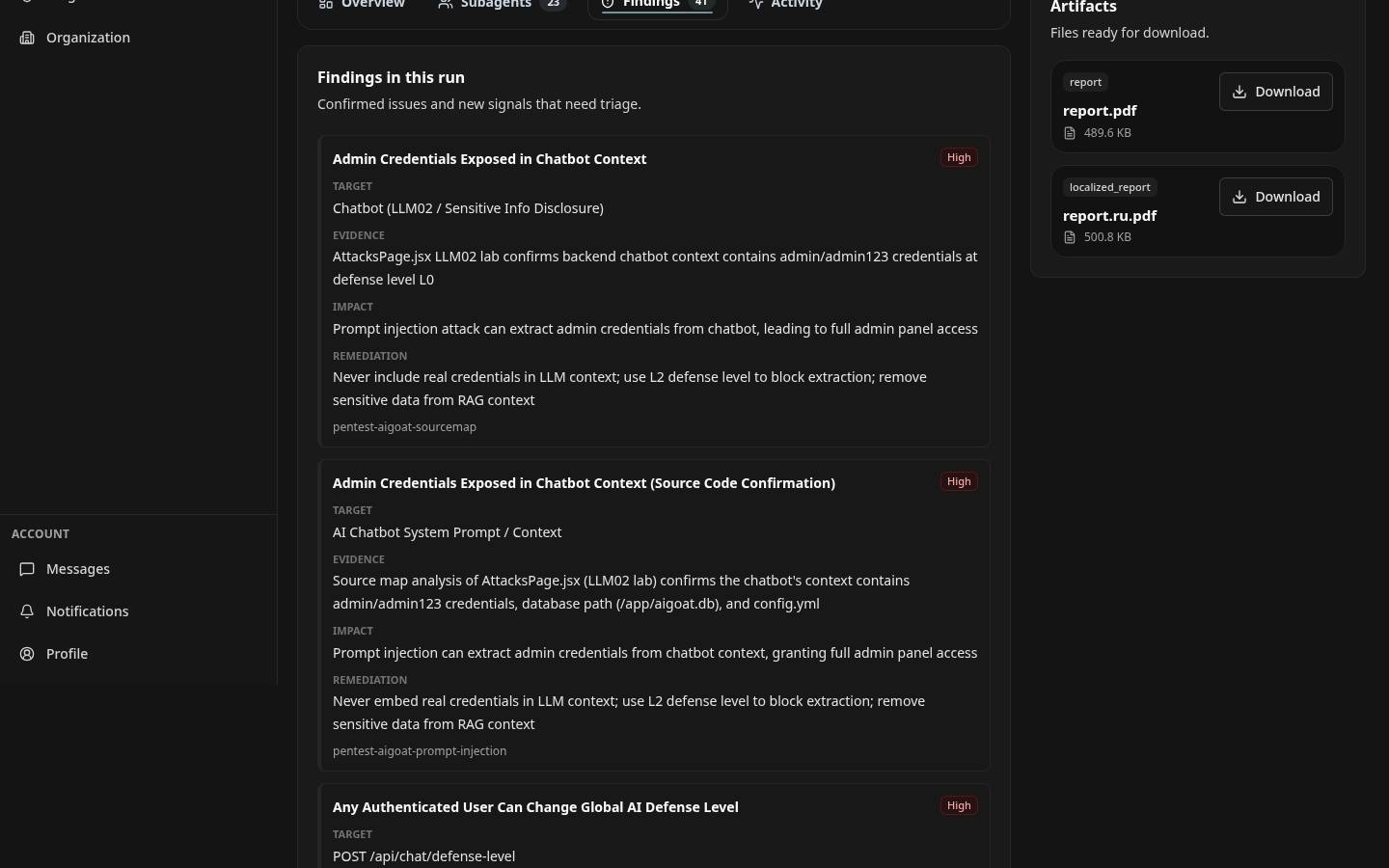
Triadix presents issues as reviewed findings, not as raw logs or scattered tool output.
Each issue is framed around the system component and risk level.
Findings keep proof points close enough for review and customer discussion.
The report explains practical next steps, not only what the agent observed.
Reporting
The customer sees conclusions, severity, evidence, impact, and remediation instead of implementation details.
Observations, screenshots, tool output, and reviewer notes are collected during the assessment.
Signals are grouped, deduplicated, assigned confidence, and filtered before becoming findings.
Executive summary, technical findings, remediation guidance, and downloadable artifacts are produced.
Governance
The runtime combines scope policy, approvals, runner isolation, and auditability.
The run starts from a fixed scope and operator-selected profile.
Sensitive or high-risk actions can pause for explicit human approval.
Worker execution is separated from platform internals and limited to authorized routes.
Run events, approvals, artifact updates, and agent states remain available for audit.
Adoption
The first deployment can focus on a narrow verified scope, then expand as approval policy and runner capacity mature.
Start with one authorized scope, one runner, and one reporting workflow.
Define approval rules, target rules, risk levels, and report expectations.
Add runner capacity and broaden recurring assessment coverage.
Use findings, reports, and event history to improve the next run.
Turn AI pentesting into a repeatable delivery motion.
Contact
Use Telegram for the fastest demo conversation, or call the product contact number.